
Italian Dual Citizenship | Investor Visa For Italy | Elective Residence
Bersani Law Firm
We are experienced Italian Immigration Lawyers and Italian Citizenship Lawyers, managed by the owner Marco Bersani, Avvocato Ordinario in Italy and Abogado Ejerecente in Madrid (Spain)
With a focus also on Immigration matters, like the Investor Visa for Italy and Elective Residence Visa For Italy.
Need a Consultation?
Contact us. We’re open Monday – Friday, 9 am – 5 pm.
Watch Latest Video and Subscribe to Our YouTube channel

![Is the Tajani Decree (Law 74/2025) already unconstitutional? Massive news for Italian descendants: Two major tribunals just ruled AGAINST the new restrictions on jure sanguinis citizenship. The Tajani Decree (Law 74/2025) already being bypassed by Italian courts - In a massive turn for jure sanguinis applicants, the Venice and Brescia Tribunals have issued rulings that favor descendants—even up to the 5th generation. What Happened: In March 2026, the Tribunals of Venice and Brescia issued landmark rulings that favor descendants seeking Italian citizenship by descent, effectively bypassing the limitations set by the Tajani Decree (DL 36/2025). This video breaks down how legal teams successfully argued that citizenship is an imprescriptible right acquired at birth, regardless of how many generations have passed. 📆 Timestamps: 00:00 Introduction 01:21 Two New Legal Precedents against Law 74/2025 05:13 #1 Tribunal of Brescia 10:31 What You Should Do Now 12:29 #2 Tribunal of Venice 12:47 Conclusions __ In this video, we dive deep into: The Venice Ruling: How Attorney Claudio Laganà built a winning case against the 2025 reform. The Brescia Ruling: Why the court recognized citizenship all the way to the 5th generation (great-great-great-grandchildren). Law 74/2025 vs. The Constitution: Why these courts believe the Tajani Decree contradicts fundamental Italian law. What’s Next: The upcoming Constitutional Court review and what it means for your pending application. Strategy: How these precedents can be used in your own judicial citizenship proceeding. __ 📌 𝘿𝙞𝙨𝙘𝙡𝙖𝙞𝙢𝙚𝙧 ❗️ This video provides general informational content and is not legal advice. Italian citizenship law is extremely complex and currently undergoing significant legal challenges. For personalized guidance on your specific case, please consult with a qualified Italian citizenship lawyer. 📌 _____ If you are an Italian-American, Italian-Brazilian, or any descendant worried about the "Great-Great-Grandchild" limit, these 2026 judicial precedents change everything. ___ Book a consultation with one of our Italian Citizenship lawyer → [https://mbersanilaw.com/contatti/] A Recent Article we also wrote: Italian Citizenship New Law 2025: Key Changes Explained And What You Should Do: https://mbersanilaw.com/italian-citizenship-new-law-2025/ Recent Video related: ❓Italian Citizenship New Law 2025 ➡️ https://youtu.be/swaH5JBYka0 ❓Italian Citizenship by Descent: Overcoming Consulate Appointment in Miami ➡️ https://youtu.be/qjgAP75auwE 🛠 Resources & Next Steps 📄 Need help starting your citizenship application? Contact our legal team here: https://mbersanilaw.com/contatti/ 📘 Additional Resources 📄 Italian Citizenship by Descent 2025 Application → [https://mbersanilaw.com/italian-citizenship-by-descent/] 🧑⚖️ Book a consultation with a citizenship lawyer → [https://mbersanilaw.com/contatti/] 🎥 Related Video: "Court vs Consulate: How to Skip the Lack of appointments with the Italian Consulate in New York " → [https://youtu.be/ptVShTIGxFA] #italiancitizenship #juresanguinis #tajanidecree #law742025 #italianpassport #dualcitizenship #italiandualcitizenship](https://mle7wstoaoqq.i.optimole.com/w:auto/h:auto/q:mauto/f:best/ig:avif/https://mbersanilaw.com/wp-content/plugins/feeds-for-youtube/img/placeholder.png "Italian Citizenship Assistance | Italian Dual Citizenship 2")
Latest Awards
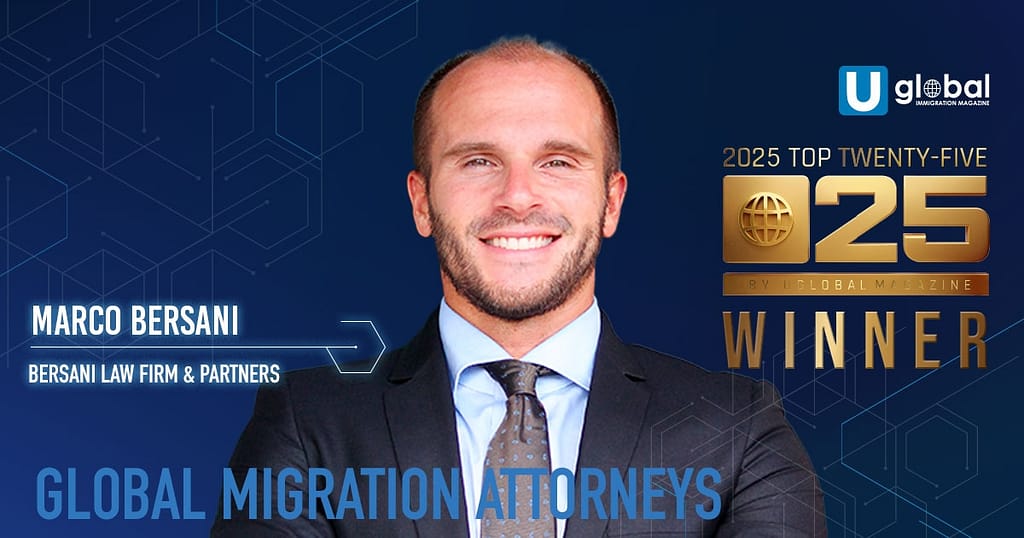
We are honored to thank UGlobal Immigration for recognizing Bersani Law Firm with the Best Global Immigration Attorneys 2025 award for Italy. This prestigious acknowledgment reflects our firm’s ongoing commitment to excellence, integrity, and client-focused legal solutions in the field of global mobility and Italian immigration law. We are grateful to UGlobal for this important recognition and to our clients and international partners whose trust and collaboration continue to inspire our work every day.
2025 Top 25 Global Immigration Attorneys
Upcoming Events & Webinars
Italy Golden Visa Webinar – NomadGate December 2025
Attorney Avv. Marco Bersani will attend as Speaker for NomadGate on December 11th 2025.
See our recent article written for NomadGate on Italian Golden Visa
Join the Live Webinar
Avv. Marco Bersani will join as Speaker at the 2025 Webinar, talking about getting residency in Italy for Investors and HNWIs interested in business and investment opportunities in Italy through the Italian Golden Visa program.
See the uncut Webinar here


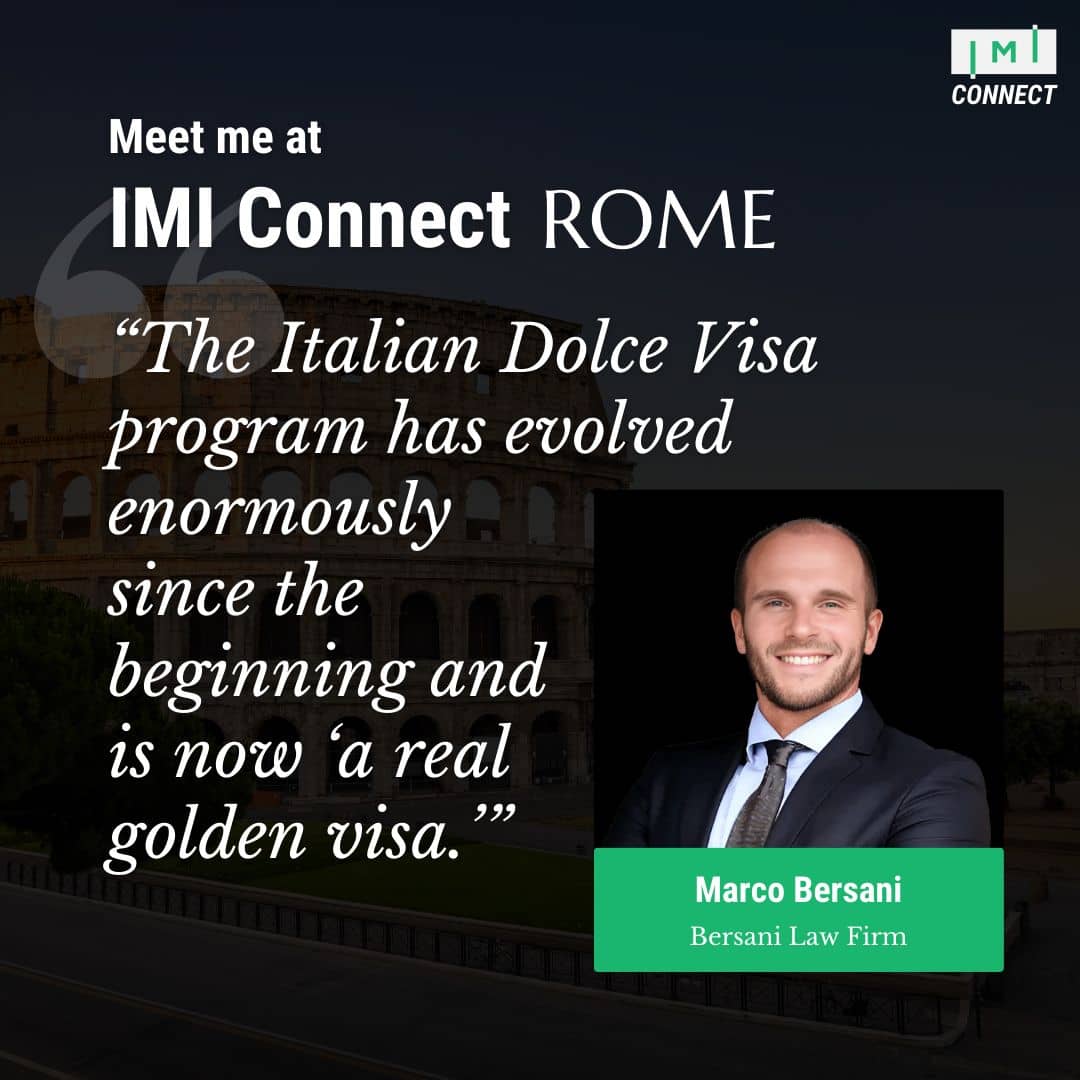
IMI Connect 2025 – Rome
Attorney Avv. Marco Bersani will attend next IMI Connect Event in Rome, Italy – on October 7th, 8th 2025.
Avv. Marco Bersani will join as Speaker at the 2025 Event, talking about Italian Immigration programs for Investors and HNWIs interested in business and investment opportunities in Italy through the Italian Golden Visa program, together with the Italian Citizenship options.
We invite all our interested Clients to join us and meet Marco during the Event.

Forbes India 2024 Event – New Delhi
Attorney Avv. Marco Bersani will attend the following 2024 Global Summit hosted by Forbes in India, New Delhi, on November 18th, 2024, in collaboration with D Globalist.
Avv. Marco Bersani will join as Speaker at the 2024 Entrepreneur Global Summit, talking about Italian Immigration programs for Investors and HNWIs interested in business and investment opportunities in Italy through the Italian Golden Visa program.
We invite all our interested Clients to join us and meet Marco during the Event.
Watch DGEMS Forbes 2024 HighLights:
Past Awards and Recognitions
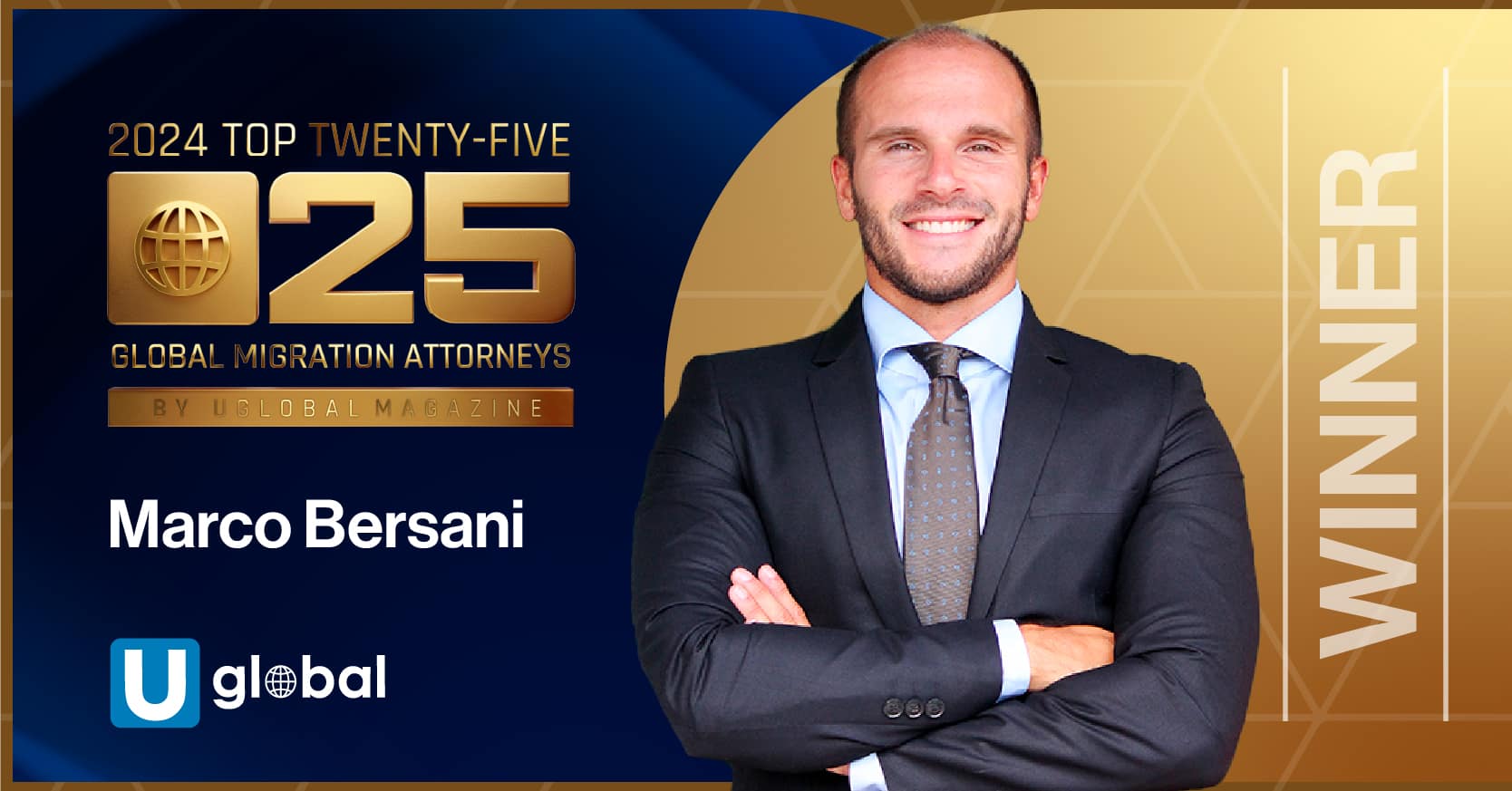
Bersani Law Firm&Partners, and Attorney Avv. Marco Bersani, , has been rewarded, for the third time, as TOP 25 Global Immigration Attorneys in 2024.
On January 17th 2025, the prestigious Immigration Company and Magazine “UGlobal” rewarded Marco Bersani, founder, and managing partner of Bersani Law into the Top 25 Global Immigration Attorneys.
Bersani Law has been selected because of the outstanding results on Italian dual citizenship applications, elective residence visas, and investor visas for Italy.
See also the Online version of the UGlobal Magazine Top 25 Attorneys
2024 Top 25 Global Immigration Attorneys

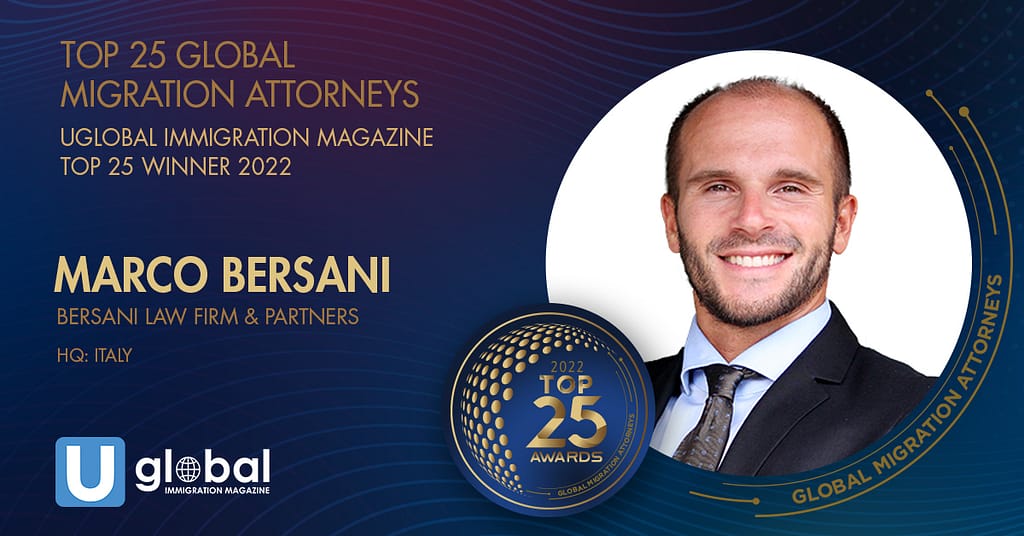
Avvocato Marco Bersani has been rewarded as TOP 25 Global Immigration Attorneys for his work as an Italian Citizenship Lawyer.
In 2023, the prestigious Immigration Company and Magazine “UGlobal” rewarded Marco Bersani, founder and managing partner of Bersani Law.
Avvocato Marco Bersani has been selected because of the outstanding results on Italian Dual Citizenship applications, Elective Residence Visas, and Investor Visa for Italy.
2022 Top 25 Global Immigration Attorneys


Legal Excellence in 2023 & 2022
53px
60px
Avvocato Marco Bersani, managing partner at Bersani Law Firm, has been rewarded as Legal Excellent in 2023 and 2022 for his work as an Italian Citizenship Lawyer.
The prestigious portal “The Lawyers Global” rewarded Bersani Law Firm&Partners with legal excellence as Immigration experts in Italy.

Excellence Legal Boutique of the Year – 2022
Avvocato Marco Bersani’s exceptional track record in handling Italian Dual Citizenship applications, Elective Residence Visas, and Investor Visa for Italy has led to his selection by the prestigious Italian Television Broadcasting “Le Fonti”.
Avvocato Marco Bersani’s expertise in Italian immigration law and dedication to his clients is unparalleled. His extensive knowledge of the requirements and processes for Italian Dual Citizenship applications, Elective Residence Visas, and Investor Visa for Italy makes him the top choice for individuals seeking assistance in these areas. With a proven track record of successful applications, he has gained a reputation for his meticulous attention to detail and ability to navigate complex legal procedures. His commitment to providing excellent service and achieving positive outcomes sets him apart in the field of Italian immigration law.

Top 10 Best Immigration Law Firms in Europe
Abogado Marco Bersani, Abogado Ejerecente in Madrid (Spain) and Avvocato Stabilito in Verona (Italy) has been recognized in the Top 10 Best Immigration Law Firms in Europe for 2022 by the U.S.-based Manager HR Magazine.
Bersani Law Firm has been selected because of the outstanding results on Italian Citizenship applications, Elective Residence Visa, and Investor Visa for Italy.
“Bersani Law Firm is currently at the forefront of the Italian immigration process. The company aims to craft an impactful future for Italy and investors planning to migrate into the country. Based on its proven track record of accomplishment in the Italian immigration domain and forward-thinking roadmap, Bersani Law was recently shortlisted in Manage HR Europe’s ‘Top 10 Immigration Law Firms in Europe – 2022.“
Manager HR Magazine
Featured on






Italian Citizenship assistance
We provide qualified assistance with Italian dual citizenship.
Our legal services are related to:




Immigration to Italy
We also focus on providing legal assistance for getting an Italian Visa.
The Visas we process are the following:



Contact us
Contact Us for a tailored Consultation on your case, and how we can assist you on the entire process.
Mon — FRI / 9am – 5pm